Fly Fishing Access
Access is part of the sport. A good arrival respects neighbors, keeps gates and banks in order, and leaves the next angler a clear path.
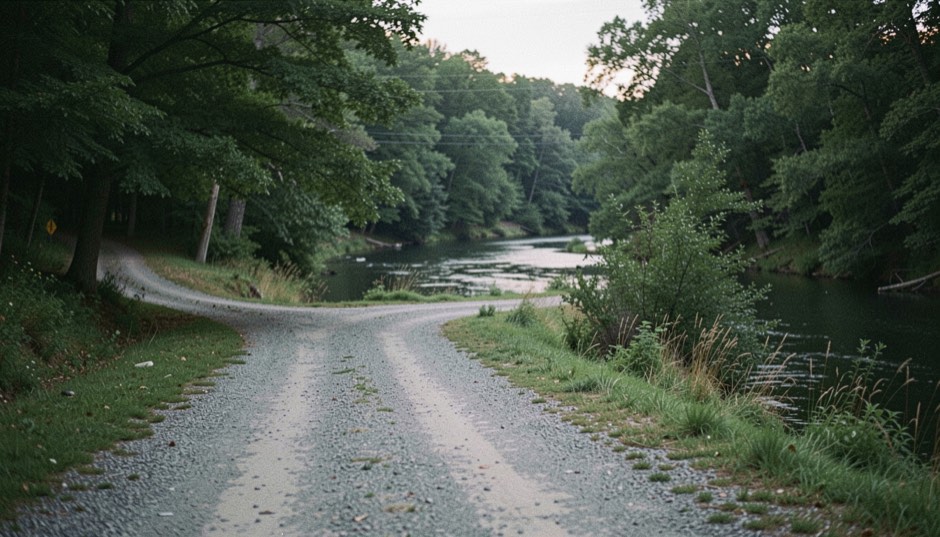
Access is permission plus practice
Fly fishing access is not just the location where a road meets water. It includes permission, land ownership, parking, safety, the approach to the bank, and the effect of repeated use. A river may be visible from public land while an adjacent bank remains private. Georgia DNR specifically reminds anglers that many trout streams are bounded by private property and that permission is required before entering private land. Start with the current manager or landowner information, then plan the route that keeps both the law and the landscape in view.
Read the signs and boundaries
Signs, gates, fences, maps, and posted instructions are part of the water. Do not treat a missing sign as permission or a familiar pull-off as a permanent public access. Confirm whether the access is managed by a state agency, the Forest Service, a municipality, a park, or a private owner. If a rule is unclear, ask the responsible authority before fishing. A careful question at home is easier than a dispute beside a river, and it protects the next angler from inheriting a closure caused by avoidable misuse.
Park like another person will arrive
A good access point remains useful when vehicles are placed where they do not block a gate, road, trail, driveway, or emergency route. Keep the car out of vegetation and avoid expanding a small shoulder into an informal lot. Take only what you need to the bank. If parking requires a fee, permit, or time restriction, follow the current instructions. A beautiful river can become unpopular when anglers make arrival difficult for neighbors or other visitors. Courtesy begins before the rod leaves the case.
Choose a durable approach
The shortest route is not always the best route. Repeated traffic on a soft bank can expose roots, widen a path, and send sediment toward the water. Use established trails and rock or gravel where available. Avoid cutting across plants, spawning areas, and unstable edges. If the only route requires damage, choose another access or another day. A wading boot can protect a foot, but it cannot make a fragile bank durable. Access is a decision about what to leave behind as well as where to step. The body pays for the approach too: a pack carried on one shoulder for a mile of rough bank is exactly the load that clinics writing about posture and headaches hear about days later.
Cross only when necessary
Crossing a river adds risk and disturbance. Before entering, assess depth, current, bottom, exit points, weather, and whether the crossing is even permitted. Keep a wading staff reachable, unbuckle a pack if appropriate, and take a route that avoids shallow habitat when a safe alternative exists. Never cross above a dam or during a generation change without current safety information. A fishable bank on the near side is often a better choice than an uncertain route to a far bank.
Share the arrival
Public access can bring anglers, paddlers, hikers, campers, families, and dogs into a small space. Keep gear organized, leave room for others to launch or pass, and communicate without treating the water as a reservation. If a group needs the channel, yield when safe. If another angler is already working a run, move far enough to create a real gap rather than leapfrogging a few steps. Shared access works when the first person and the last person both behave as guests.
Leave no new problem
Carry out line, hooks, food wrappers, and broken gear. Close gates as instructed, keep fires and waste within the site's rules, and do not move rocks or cut branches to create a cast. Do not publish private addresses, informal parking spots, or sensitive access details as though they were public directions. A useful access note points to the official information and explains what to verify. It does not expose a place to more pressure than its manager or landowner can support.
Make the return easier
Before leaving, look back at the route. Did a boot print widen a soft edge? Is a piece of line on the bank? Did a vehicle block a sign or gate? Correct what you can without disturbing more ground. Then compare the plan with river conservation, Georgia trout fishing, and fly fishing waders. The best access is not merely the one that lets an angler reach the water. It is the one that remains legitimate and welcoming after the visit.
Access also decides how often a bank gets fished, and repetition leaves marks: worn paths, packed ground, litter, and trout that move off the shallows. The same holds anywhere a repeated motion meets a fixed surface. A golf swing is a study in contact, where face angle, club path and centeredness produce every ball flight, and the short game rewards the same patience a wade demands. Players who track their rounds learn how a handicap is calculated from those scores, which is useful when reading a river that changes with each season and each angler.
Access also depends on rules that govern movement, and the same habit of counting applies away from the water. On a handball court, a player may take three steps while holding the ball, and the court itself is 40 by 20 meters with goals 3 meters wide and 2 meters high. Anglers who learn the three-step rule indoors carry that discipline to the bank, where a short approach and a clear read of boundaries keep a fishing spot open for the next visit.
For the next step, compare this note with Fly Fishing Notes, Fly Fishing, How to Read a River, River Conservation and Fly Fishing Contact. Each link keeps the same question in view while opening a different part of the river.